What Arizona Homeowners Should Use Instead in 2026 – Expert Guidance from 35+ Years in Desert Arboriculture
Arizona trees endure some of the harshest conditions in the country. Research shows desert trees can survive temperatures up to 118°F through evaporative cooling — but that survival mechanism fails quickly when nutrients and water are insufficient. When homeowners search for Moon Valley Moon Juice® alternatives for stressed trees, they are usually looking for solutions that work faster and more precisely in Arizona’s demanding soil.
Moon Valley Moon Juice® is commonly marketed as a quick nutrient tonic for trees experiencing stress. However, Arizona landscapes often require more targeted treatments because desert soils limit nutrient absorption.
As arborists with 35+ years of expertise in Arizona’s soil conditions for optimal tree and shrub health, we regularly evaluate trees that have received surface tonics but still struggle due to deeper root-zone issues.
Most tree decline in the Valley stems from root stress, soil compaction, or nutrient lockout rather than simple nutrient deficiency. That is why professional treatment focuses on root delivery, soil correction, and disease evaluation.
Before choosing an alternative treatment, it is important to identify stress symptoms early. Trees often show warning signs long before severe decline occurs.
We recommend inspecting trees regularly, especially during Arizona’s intense summer heat cycles.
• Yellowing or pale leaves
• Leaf drop during warm months
• Branch dieback
• Sparse canopy growth
• Slow or stunted seasonal growth
Revitalizes soil microbiology and corrects minor nutrient deficiencies in desert soils.
Low Cost · Easy to UseIdeal for establishing new trees and recovering from severe root stress.
Moderate Cost · Soil DrenchSpecialized conditioner for managing drought stress and improving overall tree vigor.
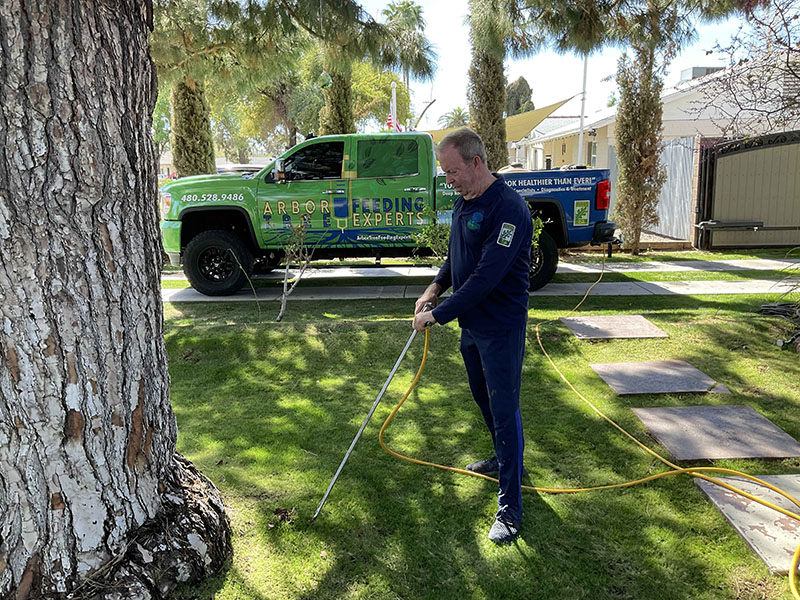
Moderate–High Cost · Foliar/DrenchDeep root fertilization is one of the most effective alternatives to surface nutrient tonics. Instead of feeding the soil surface, nutrients are injected directly into the root zone. This method bypasses soil crusting and delivers nutrients exactly where feeder roots absorb them.
Our prescription tree services use specialized equipment to distribute nutrients evenly across the root system. It is especially effective for citrus, ficus, mesquite, palo verde, and ornamental trees common in Scottsdale and Paradise Valley landscapes.
Healthy urban trees can lower surrounding nighttime temperatures by up to 22°F, making tree survival in Phoenix landscapes critical for home comfort.
Source: American Forests
Stressed trees often require a full treatment plan rather than a single nutrient product. Professional arborists evaluate soil chemistry, watering practices, and disease risks. Our prescription-style programs address the entire ecosystem surrounding the tree.
This medical-style approach reflects our philosophy developed through 35+ years of expertise in Arizona’s soil conditions for optimal tree and shrub health.
When trees suffer from severe nutrient deficiency or disease pressure, soil treatments may not act fast enough. ArborJet micro-injections deliver nutrients or treatment compounds directly into the tree’s vascular system, allowing arborists to treat problems internally with minimal environmental impact.
These treatments are commonly used when addressing fungal diseases, insect infestations, or severe nutrient stress.
Many trees that appear nutrient deficient are actually battling disease. Arizona landscapes face several aggressive pathogens including:
Professional diagnosis ensures treatments address the true cause of stress. Our arborists regularly perform evaluations through tree disease diagnosis and treatment programs.
Nutrition alone cannot solve structural stress in a tree canopy. Strategic pruning improves airflow, light penetration, and branch balance. Our team performs artistic pruning and shaping following ANSI A300 standards. Proper cuts encourage healthy growth patterns while reducing breakage risk during monsoon storms.
Arizona soil contains high levels of calcium carbonate, which raises pH and prevents nutrient absorption. This means many fertilizers remain locked in the soil instead of feeding the tree. Professional arborists account for these conditions when designing fertilization strategies.
| Soil Challenge | Impact on Trees |
|---|---|
| High pH | Blocks iron and micronutrient absorption |
| Compacted soil | Restricts oxygen flow to roots |
| Low organic matter | Limits nutrient retention |
Healthy urban trees can lower surrounding nighttime temperatures by up to 22°F, making tree survival in Phoenix landscapes critical for home comfort.
Source: American Forests
Some stress symptoms require immediate arborist intervention. If decline spreads rapidly across the canopy, delaying treatment can lead to permanent structural damage.
Modern arboriculture focuses on precise diagnosis rather than one-size-fits-all products. Our methodology follows three core principles:

Comprehensive evaluation of soil chemistry, disease pressure, watering patterns, and structural conditions.

Using deep root injection technology that bypasses compacted soil layers and alkaline barriers.

Seasonal follow-up programs, structural pruning, and disease monitoring to maintain recovery gains.
Moon Valley Moon Juice® can provide a temporary boost, but stressed trees in Arizona often require deeper solutions. Deep root fertilization, prescription tree health care, disease diagnosis, and structural pruning provide stronger results because they address the root causes of stress.
Our team brings 35+ years of expertise in Arizona’s soil conditions for optimal tree and shrub health — allowing us to diagnose problems accurately and design treatments that restore long-term vitality.
Arbor Tree Feeding Experts
Certified Arborist Since 1994
Member of BBB and ISA.
Copyright © 2024 Arbor Tree Feeding Experts. All Rights Reserved.